By the time the fire finished with my farm, forty years of work were nothing but wet ash and twisted metal, and I was standing in the rain with smoke in my hair and nowhere to go but the marble doorstep of my only daughter.
Holly opened the door in silk and soft lighting, took one long look at my muddy shoes and smoke-stained blouse, then let her husband step into the doorway like a wall made of smugness and Italian leather.
Ethan’s words slid out smooth and cruel—this was an “exclusive neighborhood,” I would “ruin his Persian rug,” and poor “failures” like me should try a shelter or a government program. My own child said nothing, just watched the door close on my face as the rain soaked through my clothes and the life I’d built.
On the sidewalk, shivering and humiliated, I remembered a worn business card I’d folded into my wallet years before, a name printed on it in deliberate ink: Marcus Rivers, CEO.
The boy who had once arrived at my farm with an orphanage duffel bag, who flinched at sudden noises and slept like he expected to be sent away at any moment, the boy I eventually adopted and called my son because no one else ever had.
My hands shook as I dialed, half certain the number would be dead or that success had sanded me out of his memory, but one word from me—“Marcus”—and his voice cracked on the word “Mom.” I told him about the fire, about standing outside Holly’s mansion like a stray dog, and I barely finished before he said, “Don’t move, I’m coming,” and hung up.
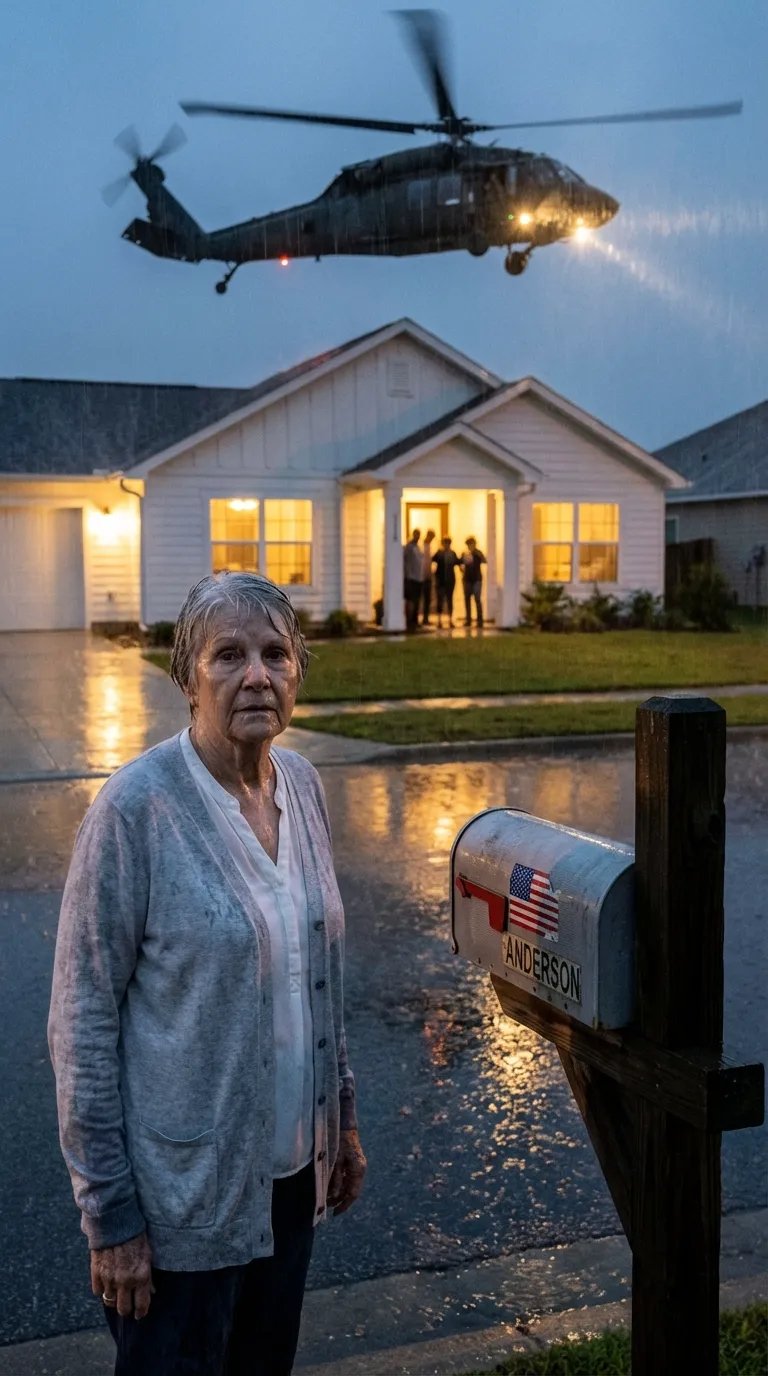
Minutes later the sound of rotor blades tore through the quiet street; a black helicopter dropped out of the gray sky and landed in the empty lot across from Holly’s perfect fountain, whipping rain and dust around like a storm sent just for us.
He stepped out in a suit that probably cost more than I’d ever cleared in a season, but when he ran to me, shrugging his cashmere coat around my shoulders and scolding me gently for standing in the cold, all I saw was the boy who used to fall asleep against my arm after feeding the calves.
When Holly and Ethan slithered out to complain about “noise” and “neighbors,” Marcus let them talk just long enough to introduce himself as the man who owned the very bank that held their mortgage, then informed them they’d be getting a letter about “irregularities” and “seventy-two hours to decide if they wanted to keep the house.”
He flew me straight to his home—a quiet kind of luxury built with books and warm light instead of fountains and pretense—and in his study, beneath a framed photo from the day I adopted him, he opened a folder that broke my heart all over again.
With the calm precision of the boy who once balanced my feed ledgers at ten years old, Marcus laid out eight years of invoices and bank statements that proved Ethan had been bleeding my farm dry—overcharging for repairs through shell companies he secretly owned, skimming commissions from loans he had “arranged,” pushing me into insurance I couldn’t afford while quietly profiting from every signature.
The numbers added up to more than one hundred fifty thousand dollars, money that had slipped out of my exhausted hands and reappeared as pearl necklaces, luxury vacations, and upgrades in Holly’s glittering life.
She knew, the statements said so in black and white; the dates of the scams lined up perfectly with the treats she flaunted while I juggled vet bills and overdue notices. Marcus had already bought their mortgage, already collected evidence of tax fraud, already prepared the letter they’d find in their mailbox.
The next day, with his phone recording on the coffee table and my hands no longer shaking, we sat in Holly’s immaculate living room and listened to their lies shrivel under the weight of paperwork.
He gave them a choice: repay my money with interest or sign the deed to the house over to me and hope he stopped short of criminal charges. Within twenty-three hours, they signed, their hands trembling more than mine, and I walked out of that place not as the unwanted, muddy intrusion but as the legal owner of every polished tile they’d ever bought with my stolen labor.
Six months later, I sit under the same sky that once watched me beg at that door, only now I’m in the backyard of my own house—the house that used to be theirs but now smells of rose bushes, clean earth, and simmering soup.
The fountain is gone, replaced with fruit trees and flowers whose roots run deeper than any pretense; the dining room that once hosted smug dinner parties now holds a scuffed wooden table, mismatched chairs, and the kind of laughter that doesn’t need an audience.
Holly and Ethan are gone to a cramped apartment and smaller lives, and while I keep a few old photos in a box out of honesty, I don’t display them; it’s hard to miss people who slammed the door on you while the ashes of your life were still cooling.
Every Friday, Marcus arrives with flowers in one hand and my favorite wine in the other, loosens his tie, and tells me about real estate projects that build homes for families who remind me of the woman I used to be—tired but still standing.
One evening he shows me a photo of Sarah’s hand with a simple ring and asks if I’ll help plan their wedding, then shyly adds that he and Sarah want their children to grow up here, with me, so they’ll know from the beginning that family is measured in love and loyalty, not blood and borrowed status.
For the first time in sixty-three years, I am not apologizing for needing help, not bending myself into forgiveness for people who never earned it; I’m sitting at my own table, in my own house, surrounded by the quiet certainty that I deserve the kind of love that runs toward me in the rain instead of hiding behind a locked door.